
Time for a quick warning before we get into this post — it will be about swearing and bad language in general. Given that I don't normally swear at all, either in text or in speech, that's going to present some problems. My general position is that I want the front page at least to be entirely suitable for all ages, so I could simply avoid saying anything throughout the post that might be offensive. However, it's going to get really confusing if I start using constructions like "that word that starts with an 'f' and is very offensive", and I consider it an intellectual cop-out of the highest order to blank out words with asterisks. Anyone who reads the post is going to be entirely aware of which words I'm actually talking about, so I'm not going to insult your intelligence by pretending that blanking it out is any better.
So, the only real solution is to quote these more objectionable words in full, and to hide the rest of the post behind a cut. So here's the warning: The rest of this blog post will contain extremely strong language that you may find offensive. If you're the kind to be offended by it and would rather not read the rest, then feel free to go on your way. Please accept my apologies, and enjoy this video of adorable kittens instead. (For those on the RSS feed or reading this post anywhere but the blog's front page: the cut will not work for you, so anything after the video is unsafe.)
Awww. How sweet. OK, those of you who are still with me, and haven't been completely overwhelmed with kitteny joy (and if not, go and take a look at Cute Overload), let's get into it.
Certain parts of language have been deemed unacceptable for polite society for thousands of years, probably since the first caveman's wife threw the first caveman out his cave for saying "oog" too many times. Shakespeare was sailing pretty close to the wind with some of his language — "zounds" appears rather a lot (source) and is short for "by God's wounds"; "gadzooks" means "God's hooks". Both are references to the Crucifixion, and in a very Christian society (like the one in which Shakespeare lived), both of those words were very offensive. Go back further to Chaucer's Canterbury Tales, and you'll see the same thing, as the Parson scolds the Man of Law for using expressions like "for Goddes bones" and "by Goddes dignitee".
As you can see, religion has long been a source for swearing. That must go back at least to the Ten Commandments, the third of which forbids misusing God's name. Even so, faith-based swearing (to coin a phrase) is clearly not the only way that people could swear in Biblical times. The book of James goes on at some considerable length about how words can be harmful ("out of the same mouth comes praise and cursing", for example), and Paul had similar things to say in Ephesians 5:4: "Nor should there be obscenity, foolish talk or coarse joking, which are out of place, but rather thanksgiving."
It's pretty clear from a Christian perspective, then, that despite swearing's long heritage, it's not necessarily a good thing to exercise one's entire vocabulary all the time (and whatever the circumstances, misusing God's name is right out). However, does that necessarily mean that there are no circumstances in which some forms of swearing may be acceptable? How about the place where it's most often controversial, in art and media? Let's take a look at a few case studies, to see how language tends to be used and what its impact is.
Stand-up comedy
I may as well come out and say right now that I'm a huge fan of Eddie Izzard, but if I'm going to do a post on swearing there's no way I'm going to avoid talking about him. Here's a clip from his show "Glorious".
In case you weren't counting, that clip contained 14 "fucks" or variations thereof, two "bastard"s, two "bloody"s, and a "Jesus Christ". And yet, I don't find Izzard remotely offensive. Obviously I'm not about to quote his work verbatim in mixed company (I tend to strategically miss out words, of which more later), but I'm more than happy to watch him for hours despite the near-constant barrage of four-letter words. I think the reason is that the swearing isn't the point of the joke. In the above clip, for example, it serves as little more than punctuation — his miming and observational humour is considerably funnier than the fact that he's saying "fuck" a lot, but the swearing does also help to give him a rhythm and a recognisable vocal persona.
Now, contrast that with Billy Connolly. (OK, this is a little unfair, as this clip is Connolly on the subject of swearing, but still.)
Don't get me wrong, that's still funny (and Connolly does make a good point, which we'll come back to in a bit). However, because the swearing is the point of the joke — note how everyone's in raucous laughter after the first bellowing "FUCK OFF!" — I don't find it nearly as entertaining, and I certainly wouldn't be happy showing it to anyone else. (Apart from all of you, of course.) When swearing gets you a laugh, regardless of what else you might be saying, it must be very tempting for comedians just to sprinkle a few swearwords in and leave it at that.
Films
The first time I watched the classic The Silence of the Lambs, I don't think I knew what certificate it was. I wasn't left in any doubt, however, when about three minutes in, Miggs, one of the prisoners in Hannibal Lecter's cell block, snarled "I can smell your cunt!" at Clarice Starling. Bang, instant 18 certificate. Now, The Silence of the Lambs is not a nice film anyway, and the violence later on would push it well into 18 territory regardless of the language used. Nevertheless, the tone is set very early on. Having seen very little of the film, we're already aware of the kind of person that Miggs is, and (by extension) the kind of person that Lecter must also be, to be locked up with him. It's very clever writing, which works because of the choice of language rather than despite it.
On the other hand, we have films like Wanted, on which I made my opinions abundantly clear some time ago. A quick search of an early draft of the script reveals 25 uses of the word "fuck" (again including variants), 18 uses of "shit", and (somewhat surprisingly) only a single "dick". This is a film that is trying very, very hard to be edgy and controversial, but completely fails on every level by being utterly ridiculous. As such, the swearing doesn't add anything to it, and simply feels like it's overdoing it to no great effect. (And in case you were wondering, The Silence of the Lambs makes it to a comparatively clean eleven uses of "fuck".)
So far, then, it seems that swearing can be a valuable tool for creating an atmosphere, but because of its potency it requires good writing and acting to then back up that atmosphere with something more meaty. Get it wrong, and your atmosphere becomes a load of hot air, and becomes offensive not only for the swearing but only because you can't believe you just paid money to see something quite so poor.
Books
As words are obviously the key medium for carrying information in books, far more than for any other medium, this is a pretty huge topic. As such, I'm not even going to try to cover the whole thing. Instead, let's look at just one example of how swearing can work with not swearing to create something very impressive.
The example I'm going to use is from Terry Pratchett, one of the authors I read more than anyone else when I was younger, and who still sits comfortably in my list of favourite writers. He has a real gift for language, but doesn't go in much for lyrical word-pictures. His speciality is more that he picks the right words for the task, and brings about the effect he wanted in just a few words. He also tends not to swear at all in his writing, and in fact turned that very fact into a joke in his novel The Truth, in which one of the characters constantly left gaps in his speech, such that the other characters kept remarking on what the word "___ing" could possibly mean. So it was quite a surprise to suddenly hit this near the end of the book Hogfather:"Worlds of belief, she thought. Just like oysters. A little piece of shit gets in and then a pearl grows up around it."
That use of "shit" shocked me when I reached it, not because the word is inherently shocking, but because the whole book is about children and how their beliefs shape the world around them, and the language tends to match that. Having had nothing that could be remotely construed as offensive for page after page, that one word was a jolt, and one that gave the metaphor being used a lot more potency.
Perhaps more importantly, there is no word that could have been used in that metaphor that would have had quite the same impact. Evoking an extreme of distaste shortly before swinging it back to beauty with the word "pearl" is a very clever construction, and serves to turn something that was horrible into something wonderful.
Music
So, was Billy Connolly right? Are there situations where you just don't get the right effect unless you're swearing? I would suggest so. One of my favourite musicians, Mark "E" Everett of American rock band Eels, penned a song that illustrates this perfectly. Do me a favour — hover your mouse over this link, close your eyes so that you can't see the title of the song (the link takes you to Youtube), and click. Listen through the beautiful piano-and-strings introduction, and pay attention to the lurch that the opening line of singing produces. Go ahead, I'll wait.
For those who didn't follow those instructions, I'll just plough ahead anyway. I'm entirely aware that the word "motherfucker" is extremely unpleasant. The word doesn't even sound nice, even if you don't pay attention to its connotations. And yet, E has used it brilliantly here. He's taken the depth of feeling that the word evokes (and it's pretty deep), but instead of directing it into anger, he's made it melancholy. The overall effect is one of incredible sadness, giving us a feeling of great loss and tragedy, and he's done that in hardly any words. Once you take into account that E has had a very difficult life (and he wrote that song mere months after his mother died of cancer, practically in his arms), you begin to feel that (to quote E way out of context) "if anyone knew that it is, indeed, a motherfucker", it's him.
The same effect is present on other songs, too. Radiohead's "Creep" is a prime example; when Thom Yorke sneers "I wish I was special / You're so fuckin' special", it turns what could be an expression of admiration into a sarcastic dismissal. Other words don't quite cut it — the radio-friendly version replaces "fuckin'" with "very", which still kind of works, but doesn't have the same bite to it. Conversely, I almost always skip over REM's "Star Me Kitten" if it comes up on shuffle, because of the chorus:You, me, we used to be on fire
I can't pretend to completely understand Michael Stipe's lyrics (in any of his music, come to think of it), but this seems like a very bleak song. I can't detect any love in what's being said, and the use of "fuck" here just seems cold and empty. It's unnecessary, and adds nothing to the song, which allows its inherent offensiveness to take over again.
If keys are all that stand between,
Can I throw in the ring?
No gasoline
Just fuck me kitten
You are wild and I'm in your possession
Nothing's free so, fuck me kitten
The mention of "Creep" above takes us into the final thing I want to talk about, which is censorship of swearing. Because it has been decided that certain words are not for young ears (a concept that seems fine in principle, but leads to some strange effects in practice), music producers have come up with a number of ways of making sure that young people can still buy their songs. The first is simply to blank out swear words, either by beeps, or by cutting the volume of the vocal track at that point, or even by playing the swearword backwards. I have very little time for this tactic — as I said in the introduction to this post, anyone who hears a bleep is certain to be able to work out from context what the word actually was, and therefore has experienced the swearing just as much as someone who hears the unbleeped version. Worse than that, even if the bleeped word was actually not that offensive, they're now imagining the worst. If you don't believe me, have a look at this, and see what your brain fills in.
Alternatively, artists sometimes record a completely different version. We've covered "Creep" already, which at least doesn't do too much damage to the song; it can, however, get ridiculous. The worst offender I've seen recently was Katy Perry's "Hot and Cold". The song itself isn't bad, as songs go — fairly chirpy dancy pop, with pretty funny lyrics and a good hook. However, a couple of lines in the first verse caused trouble with the censors:"You change your mind
Not even that offensive, really. Perry gets away with making a PMS joke by virtue of, well, being a girl, and also because she does so in a self-deprecating way. The meaning she's going for is "you act like a cranky bitch, and as I'm a cranky bitch myself, you'd better believe me."
Like a girl changes clothes,
And you PMS
Like a bitch - I should know..."
Once the censors got their hands on it, though, the word "bitch" was replaced with "girl". Suddenly, not only does it become way more offensive, implying that all girls are cranky and irritable, but it also makes absolutely no sense. "You act like a cranky girl. I'm a girl too." Yes, Katy, we had noticed. You're wearing a dress. It was fairly obvious, really.
So, after nearly 2,500 words, we come to the conclusion. Unfortunately, I don't know what it is. Is swearing something we should probably try to cut out of everyday language? Yeah, I think it probably is — for the most part, it doesn't really do a whole lot of good. Are there times when it is necessary? Also yes. Now and again, a swearword is the only one that could possibly fit with the concept you're trying to evoke (Margaret Atwood makes a very good case for her use of "fuck" in The Handmaid's Tale, for example). And can you frequently get into difficulties when trying to remove bad language from art? Most definitely.
So how do we reconcile those ideas? Probably not with hard and fast rules. What's offensive for one person may not be for others (I'm guessing that if you're still here and didn't abandon ship shortly after the kittens, you're not easily offended), so give and take is definitely going to be required. And this is the important part — give and take doesn't mean that one side only gives and the other only takes. If you're not comfortable with swearing in media, that's fine, but please understand that there are those of us who don't mind it and think it can be useful without being offensive. Likewise, if you swear like a longshoreman, be aware that someone who doesn't like hearing certain words is not actually trying to infringe upon your human rights.
You know, I wish my posts didn't end so frequently with the equivalent of "so basically we should all be nicer to each other," but seriously people, isn't it a message worth hearing?
Tuesday, 11 August 2009
Typing this up was not as cathartic as I'd hoped.

Sunday, 26 July 2009
A change is as good as a rest, or so they say.
As promised, The Beautiful Hypothesis has undergone a redesign. New colour scheme, new logo (it's new by default, I suppose, given that I didn't use a logo at all before), slightly cleaner design, and fewer gadgets cluttering up the sidebar. Oh, and the post expansion function works again, although it isn't running on my own code (that turned out to involve rather more complicated Javascript than I'm capable of managing).
It is entirely possible that I've broken some of the old posts, or made them look weird. If you happen to notice anything going wrong (or more wrong than before), would you be so good as to drop me a note, either in the comments or to the email address in the sidebar? General comments are also welcome — for instance, I'm not sure whether I've hit that sweet spot colour-wise between "so vivid it burns our eyes, preciousss" and "so gloomy it makes me want to cry".
Normal posting service should resume shortly. Thanks for your patience!
Thursday, 23 July 2009
Thank you for calling The Beautiful Hypothesis Technical Support. All our operators are currently busy. Please hold...
You may have noticed if you've been here recently that the "Continue Reading..." links, which function in much the same way as a LiveJournal cut (ie. they hide the particularly long and/or boring bits of the post and let you just read a few paragraphs if you so wish), have suddenly stopped working. This is because of rather poor design on my part, I'm afraid — you'd have thought that even two and a half years ago, I might have been technically savvy enough to realise that making your entire blog dependent on code that was hosted on some complete stranger's server was a really bad idea, for quite a number of reasons — but there we go.
The upshot of this is that any post with a "Continue Reading..." link will continue not to work until I replace the missing code that used to do the expansion with some of my own. It may take me a few days to get round to doing that, so I may as well fold it into a full redesign that I was planning to do anyway. (Various shades of brown are so mid-2007.)
With any luck, I should manage to do that this weekend, so the problems should be fixed by then. In the meantime, if you want to read any post which does have a broken "Continue Reading...", just click on the post title. That should load the entire post, including the content from behind the cut, in a new page. Or alternatively, use the RSS feed, which doesn't include cuts at all.
Thanks, and sorry for the inconvenience!
Saturday, 18 July 2009
How come it's never the Communists doing this? We do still have a Communist Party, right?
Blimey, it's been a long time since I posted anything here. Consider it an extended summer recess. In the time since the last post...
- I've moved house
- I've spent two weeks in Wales (which has sparked some interesting ideas — couple of posts in the pipeline for that one)
- Swine flu returned to the news, despite being largely ignored by most people
- Norway won the Eurovision Song Contest with a record-breaking score that it really didn't deserve. Come on, people, it was hardly Hard Rock Hallelujah.
- Michael Jackson died and had the most bizarre funeral ever seen
- Sarah Palin quit politics, at least until she decides to announce her 2012 candidacy and makes the Internet a horrible place to be once again
- Roger Federer surprised absolutely nobody by winning Wimbledon again, and Andy Murray also surprised nobody by not winning Wimbledon (one day, Andy...one day...)
If you get the impression that I'm not overly thrilled with this development, you're entirely correct. The BNP (no, I'm not going to link to their website — Google it if you really want to) is a horrendous organisation, committed to the idea that non-white people are inherently inferior to whites. Their policies include bringing back corporal and capital punishment, "voluntary repatriation" of immigrants (and you can imagine just how "voluntary" that would really be), criminalising mixed-race relationships, and barring the provision of any public money to "non-British" (for which read non-white) organisations. Nick Griffin has done his very best to hide the party's ugliest attributes under a veneer of respectability, but quotations like "power is the product of force and will, not of rational debate" and a call to support its policies with "well directed boots and fists" show you where his sympathies really lie.
It is very important that we prevent the BNP from ever getting any real kind of power. However, I have to say, I'm not that worried about them, for two main reasons. The first is that Britain is not actually populated by a jack-booted horde of thugs. The vast majority of people vote for parties that advocate policies in line with basic human decency. You'll notice that the BNP is the only far-right party that even gets any attention in the media, for the simple reason that none of the others ever get enough support to even mount candidacies, and they've managed that precisely because Griffin has been actively trying to hide their racism.
The second reason is that the BNP do, in fact, provide a useful function in British politics. So long as we can keep them from gaining any real power, but keep their supporters thinking that they might, the BNP will act as a filter, funneling all the foaming Nazi lunatics off into itself and keeping them out of the major parties that might actually stand a chance of getting power.
To see what happens when the far-right parties get marginalised almost out of existence, you only have to look at the USA. There, the racist morons and rabid far-right have all ended up going into the Republican party, where the voice of sensible small-c conservatism (advocating small government, reduced taxes, personal responsibility for finances — things that are incredibly valuable to public discourse, even if I don't think they're always the right way to go) can all too often be drowned out by "they're taking all our jobs! Kill everyone who doesn't look like us!"
You don't have to look too far to see this happening. It reached fever pitch during the recent Presidential election (this is the kind of thing I'm talking about - not safe for those who get angry easily), but elements of the same craziness are present right up to the top. See, for example, Sarah Palin trying to paint Barack Obama's supporters as not part of "real America", or Minnesota Congressional Representative Michele Bachmann making a terrifyingly McCarthyist call for Congress to be investigated to see which of its members were anti-American. And if you've got some time on your hands, read this illuminating article to see what the American right gets up to when it thinks the journalists aren't around.
So should we be opposing the BNP? Oh, yes. Any power they do manage to get is undoubtedly too much, and any of their influence is most unwelcome. But at the same time, they're a useful safety valve. We're always going to have right-wing racist nutjobs in this country — we have a long record of breeding them (hi, Oswald Mosley!) But we have a record just as long of not electing them, and that's the key. In the meantime, those on the left should be concentrating their efforts against the slightly more moderate right. UKIP made huge gains in the European elections, for example, and a party that decides it has to put "non-racist" in its search engine result summary (see result #1) doesn't exactly fill me with confidence. Neither do their rather worrying manifestos, which seem to promote deregulation of practically everything.
Not that it matters too much right now, anyway. We're some way off the next election — Gordon Brown is almost certain to hang on until the last possible moment. And, while crazy racist nutjobs are undoubtedly a problem...
...they're a problem that can easily be handled with eggs.
Sunday, 3 May 2009
Constable does not know the power of the Dark Side...
Taking advantage of the lovely weather and the Bank Holiday weekend, I ventured into London once again yesterday, and did Cultural Stuff. By which I mean that I went to the National Gallery. And it was there that I found out several fascinating things.
- Pictures of Mary and the infant Jesus were remarkably popular a few hundred years ago.
- Almost without exception, the infant Jesus is portrayed in these pictures as either gigantic, or terrifying, or sometimes (for bonus points) both.
- A subset of these pictures involve Mary nursing Jesus. The artists who produced these ones seem to have had some very funny ideas about female anatomy. One in particular (which I sadly can't find on the National Gallery website) appears to suggest that Jesus was able to feed by suckling Mary's collarbone.
- While we're on the subject, this is Jan Gossaert's Adam and Eve:
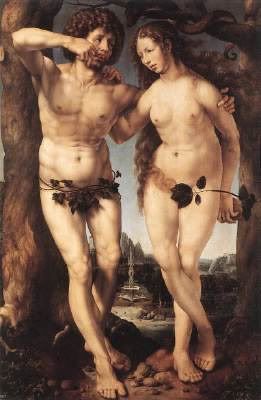
Not only is Adam sporting a fine 'fro, he also seems to have just as well-developed a chest area as his wife. Maybe Gossaert only knew extremely thin women or something. And those trees are clearly both sentient and easily embarrassed. - Seeing a painting in the gallery lets you pick up on all sorts of details that you might otherwise miss. This, for example, is John Constable's The Hay Wain.

You've probably seen that painting a hundred times. At my primary school, we even had an enormous version of it done as a collage (although that's understandable, given that the school was about twenty minutes' walk away from the spot where Constable painted it). But I bet you never noticed who was hiding in the reeds over to the right...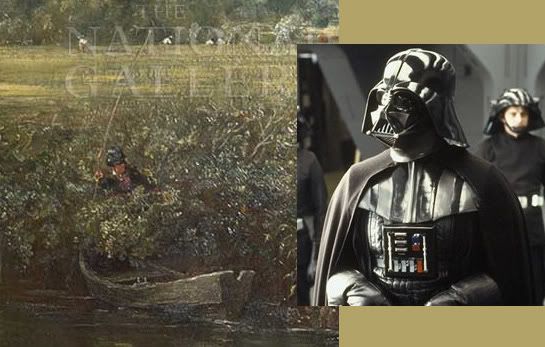
Uncanny, eh?
Time for boring copyright stuff! So, none of the images here are covered by the blog's CC licence. I reckon all of them are, for this specific use, covered by the Fair Dealing provision of UK law (and in any case they're hosted on Photobucket, which is a US-based service, so fair use probably applies too). As you can tell from the watermark, the detail from The Hay Wain was unceremoniously yoinked off the National Gallery website. Everything else is either from Wikipedia or from other online image repositories (or in other words, I can't quite remember).
Monday, 27 April 2009
For the record, I wrote the original email before the G20. It would have been rather angrier if I'd waited a week or so.
As you'll notice if you look back a couple of posts, I sent an email off to the Home Office the other week about the frankly appalling Policing Pledge posters currently around the UK. Well, in a move that has left me pleasantly surprised, the Home Office has responded! (By sending an email with the letter in an attached Word document for some unfathomable reason, but you can't have everything...)
23 April 2009Well, I have to say, Duncan, that's a rather more pleasant response than I was expecting, given the levels of snark I threw at you, so bonus points there. On the other hand, I'm not at all sure what "we note your concerns" means; it sounds suspiciously like "thanks for writing, but we're not going to so much as acknowledge the possibility of changing anything we do".
Dear Mr Brien
Thank you for your email of 29 March 2009 to the Home Office about the Policing Pledge. As the Home Secretary receives a large amount of correspondence and is unfortunately not able to respond to each item individually, I have been asked to reply.
As you will know, all 43 forces have implemented the Policing Pledge. This is a fantastic achievement and means that now, for the first time, the public know the standard of service they can expect to receive from the police and have a greater say over the issues that they would like the police to prioritise in their local areas.
The communications aim is to make the public aware that they now have access to local crime information through an improved online service via Directgov. This includes a better and quicker search by postcode taking the public directly to improved Neighbourhood Policing Team pages on force websites via www.direct.gov/policingpledge which also has more information about the Pledge and a facility to search by postcode or map for your local contacts and your local crime information.
We note your concerns, but would like to thank you for taking the time to write and also your support for the Policing Pledge.
Yours sincerely
Duncan Mitchell
Nevertheless, the air of form letter that pervades the whole thing does at least suggest that they've sent quite a lot of letters similar to this one. Can but hope that if enough people did, then the message has got through that maybe accidentally threatening the public with poorly-worded signs isn't the way to go..
Thursday, 9 April 2009
Assuming Men Can Fly: Apocalypse in the Year 3000
I've been without the internet for the past few days, after Thames Water managed to dig through an "uncharted obstruction" on the Olympic stadium site which turned out to be one of BT's major communications links. Suddenly BT was running on hugely reduced broadband capacity, which meant that everyone to whom they acted as a broadband wholesaler was also having problems, bringing pretty much all ADSL connections in much of England to a shuddering halt. Not the ideal way to spend a week's holiday, but oddly calming.
Not having web access has meant that I've had plenty of time to watch DVDs with my family, one of which has been The Big Bang Theory, a fairly new US sitcom about two nerdy physicists whose geeky lives are interrupted by the arrival of an attractive young woman in the flat next door. Hilarity, as they say, ensues.
The show's main attraction is not the storylines — practically nothing actually happens from week to week. Rather, it's the interactions of the main characters, most of whom are the most insanely nerdish people you've ever seen. Speaking as someone who is not only a fairly high-level geek, but also lives and works with them every single day, and indeed celebrates his geekishness, I can confirm that although The Big Bang Theory's nerds are exaggerated, it's not really by that much. The reason the show works is that it goes far enough from real life to be funny, while still letting the true geek see himself (or, rather more rarely, herself) in some of the behaviour on screen.
For example, in one of the earliest episodes, our four loveable nerds get into a protracted argument about the physics of Superman, and why Lois Lane should have been cut into three equal parts by Superman's arms of steel when he caught her after a fall of several hundred feet. This is something that I love doing — taking the rules presented by a work of fiction, and extrapolating them to test their internal consistency. Star Trek nerds are famous for it, to the point where the show's writers went so far as to rewrite bits of the script to acknowledge problems pointed out by fans.
I like doing this so much, in fact, that I'm going to give it the kiss of death by starting yet another occasional blog feature. I'm fully aware that most of these are languishing in one- or two-post obscurity by this point, but screw it, it'll be fun while it lasts. In homage to its sitcom roots, I'm calling it Assuming Men Can Fly.
Entry #1 in this series is something that has bugged me for entirely too long — the lyrics to Busted's song "Year 3000". Here's the song in all its questionable glory.
I'm fully aware that there are plenty of reasons to dislike Busted, but I'm not really objecting to this song on most levels. It's chirpy, fairly harmless, and considerably better than the saccharine version by the Jonas Brothers, which manages the rather implausible feat of censoring Busted's lyrics while Auto-Tuning the vocals more than I thought possible. No, my objection is based purely on the mathematics of that chorus.He said "I've been to the year 3000,
OK, let's look at the rules under which we're operating. The first verse has already provided the premise — the singer's next-door neighbour Peter is capable of visiting the future and has in fact done so. We therefore have to assume that time travel is possible, that Peter is not lying, and that his report of the year 3000 is essentially factually accurate. Other than that, the present-day world in which the song takes place is indistinguishable from our own, so we can assume that all its restrictions apply equally well.
Not much has changed, but they live underwater,
And your great-great-great-granddaughter,
Is pretty fine."
The problems focus on the singer's great-great-great-granddaughter. The singer himself is in his 20s in the above video — let's make the (not unreasonable nowadays) assumption that he will be about 40 when his last child is born. Over the timescales we're looking at, we're as nearly as makes no difference at the year 2010 right now, so we can therefore assume that this child is born in approximately 2030. Let's chart the data so far. Generation Year of birth Age at birth of last child Singer n/a 40 Daughter 2030
Next, we'll assume that medical science advances at such a rate that in each successive generation, lifespan and general health have increased the age at which you can successfully have children by 20 years. That's probably quite a generous assumption, but the song's optimistic enough (at least at first glance) to think that we won't have wiped ourselves out with nuclear war, overpopulation or disease epidemics in the next 1000 years, so let's go with it. That puts the singer's daughter at the age of 60 when she has her last child, so we can fill in the next row of the table as well. Generation Year of birth Age at birth of last child Singer n/a 40 Daughter 2030 60 Granddaughter 2090 80
From there, it's a pretty simple operation to fill in the next three generations as well. Generation Year of birth Age at birth of last child Singer n/a 40 Daughter 2030 60 Granddaughter 2090 80 Great-granddaughter 2170 100 Great-great-granddaughter 2270 120 Great-great-great-granddaughter 2390 140
So essentially, the singer's great-great-great-granddaughter — who, we are told, is "pretty fine" in the year 3000 — is also six hundred and ten years old. Even with our generous assumptions about medical science, this seems rather implausible — even if she's somehow managed to live that long, the odds of her looking "pretty fine" are slim enough that it tells us rather more about Peter's taste in women than it does about the future.
So, like all good scientists, the first thing we change is our assumptions. The first thing we can do is assume that the last child in each generation, apart from the great-great-great-granddaughter herself, is always male. Men can reproduce to a much greater age than women (practically to the end of life), so if we make the assumption that this is what's happening (despite the rather unpleasant accompanying mental images), we can get a much bigger increase in reproductive age in each generation. Let's assume that longevity is improved to much better degree than maximum age of childbirth, and that 40 years are therefore added to each successive generation. Our table now looks like this. Generation Year of birth Age at birth of last child Singer n/a 40 Son 2030 80 Grandson 2110 120 Great-grandson 2230 160 Great-great-grandson 2390 200 Great-great-great-granddaughter 2590 240
Hmm. Well, it's an improvement, but not a great one — now she's a sprightly 410 years of age when we see her. Clearly there's a gap somewhere of several hundred years, during which no successive generations are produced but the family continues. There are several mechanisms by which this could happen.
All interesting possibilities, and I'm certain all of them have been used in science fiction stories before now. But which, if any, has occurred in this case? The clue is in the chorus reproduced above.Not much has changed, but they live under water...
This seems to suggest that option one is the most likely. A disaster of Biblical proportions has either caused the sea levels to rise, or rendered the land uninhabitable, with the result that humanity now lives under the sea. It has also apparently changed human physiology (a later verse suggests that there are now three-breasted women who swim around totally naked), which may indicate a higher rate of mutations, possibly indicating in turn that the land's surface is off limits due to dangerous levels of nuclear fallout. In this reading, "Year 3000", far from being a perky song about time travel, is actually a dire warning about the coming threat of nuclear Armageddon.
However, there is an alternative reading, suggested by the lyrics of the last verse:I took a trip to the year 3000,
A cursory reading of Busted's Wikipedia page shows that, prior to their split in 2005, the band in fact released only two albums. This suggests a fifth possibility:
This song had gone multi-platinum,
Everyone bought our seventh album...
The question now, of course, is this: if our cheery spiky-haired singer went off into that timeline, and his offspring populate that one rather than this one, presumably he stayed there. Does that mean that, in the song's universe, the members of Busted no longer exist within the world as we know it?
And if so, please can I go there?


