Tuesday, 17 February 2009

Ever wanted to live in the '50s for ever? Yeah, won't sound so appealing in a few minutes.

Around the New Year, a couple of things happened that I meant to post about, but haven't got round to until now. One of those was the fact that the character of Popeye is now in the public domain within the EU, but really, aside from putting a few pictures of Popeye in the post there's not a lot I can do with that.

Above: Public domain in the EU. Which is where the server hosting it happens to be. Har.

So let's look at the other (and rather sadder) event that happened around Christmas: the death of Henry Molaison, known to thousands of psychology students simply as "HM".

I first learnt about HM in my first year at university, when I was first being introduced to the neurophysiology behind memory. It's a fearsomely complicated topic — we spent a considerable time covering the debate about what the different kinds of memory even were, let alone how they worked — and it was impressed on us very quickly that there is no single part of the brain that "does" memory. We learnt about Karl Lashley, the American mad scientist neuroscientist who removed progressively more and more brain tissue from a rat, observing how it never suddenly lost the ability to run a maze. We listened to lecture after lecture as various learned people found new and interesting ways of saying "yeah, we don't really know how this works".

And then, bringing it all into clear and frighteningly relevant focus, along came HM. He was born in 1926, and developed very severe epilepsy at a young age. In an attempt to cure him that some would describe as "experimental" and others would describe as "ludicrously reckless", surgeon William Scoville removed pretty much all of his posterior hippocampus, along with a few other bits that he wasn't even aiming for. In case you're a bit rusty on your neuroanatomy, the hippocampus is a small, seahorse-shaped bit of brain, buried deep in its craggy folds, which is instrumental in the formation of short-term memories and in spatial reasoning.

"Why, that's foolish," you're probably thinking. "If Scoville knew that, why on earth did he remove it?" Well, he didn't know it at that point. Indeed, the main reason we know anything about the role of the hippocampus in laying down memories is that HM, immediately after recovery from the operation, was entirely unable to remember anything that had happened more than a few hours previously.

Although he was cured of epilepsy, HM was now suffering from a condition called anterograde amnesia. This isn't the type of amnesia that Hollywood loves so much, where you forget who you are but otherwise function perfectly normally (that's retrograde amnesia, and is usually considerably more debilitating than your average schmaltzy matinee movie would have it). Instead, HM remembered most of the events that took place up to his operation, but woke up each morning with no idea of what had happened since then.

It's a testament to the strength of HM's personality that he didn't go completely insane. Scoville, presumably in an attempt to work out which bits of the brain he shouldn't take out next time, worked closely with him for years afterwards, but every day HM met him for the first time. Every day he had to learn what was wrong with him, every day he had to come to terms with a world that was unaccountably no longer in 1953. Worse than that, he had to cope with the vast numbers of people who knew absolutely everything about him, but who (as far as he could tell) he had never met.

One of the insights that HM brought us was the difference between episodic memories (those about a particular event) and procedural memories (those covering general abilities and knowledge that you don't realise you know). Although he couldn't form the episodic memories necessary to remember one day to the next, he did pick up skills. One of my tutors told me, for example, that HM was a stunningly good table-tennis player, despite thinking that he had never played it before — years of playing his first game again and again had left their mark. Essentially, he lived a reverse Groundhog Day — the world moved on, while he went round in circles.

Back on my old blog, I posted a quotation from HM that was in one of my textbooks. I'll repost it here:

"Every day is alone in itself, whatever enjoyment I've had, and whatever sorrow I've had...

Right now, I'm wondering. Have I done or said anything amiss? You, see at this moment, everything looks clear to me, but what happened just before?

That's what worries me.

It's like waking from a dream; I just don't remember."

Well, if Dory's words back in this post were sad, that should have you bawling. HM was isolated from the world in a way that we can't imagine, unable to form any lasting relationships, and presumably aware every day that all he was experiencing was about to ebb out of his mind, never to return. Even though he was famous (albeit among a very specific section of the population), he remained anonymous to all those who knew about him, known to us all just by his initials.

On the 2nd of December last year, Henry Gustav Molaison died of respiratory failure in a nursing home in Connecticut. I didn't know his name or see his picture until after his death, but even so, I wish I'd met him. He contributed enormously, without knowing he was doing it, to one of the most fascinating and important branches of science affecting us today, and he lived one of the most difficult lives imaginable, by all accounts in a gracious and polite way.

Wherever he is now, I hope Henry is remembering everything that happened to him, all the people he ever saw, and all the ways he was able to make a difference.

And I hope he's playing a mean game of table tennis.

Continue Reading...

Saturday, 14 February 2009

Why are pink fluffy hearts romantic, anyway? Surely that would be a sign of some really horrible heart condition?

So once again it's February 14th, the day originally named forone or more early Christians whose only known action was to die horribly at the hands of the Romans. It's not clear exactly why this has anything to do with sending someone a card with a huge pink fluffy heart and/or teddy bear on it, although Wikipedia (that fount of all knowledge) suggests that the celebration of love was one of the festivals of the early Britons, built on by the Church. If that's the case, then the Church has done a singularly bad job at putting any kind of Christian message into the occasion. When Clinton's Cards are more enthusiastic about a Saint's Day than the Church is, you know something's gone wrong.

In so far as it's possible to call something a tradition when you've only done it twice, it's traditional on this day for me to post a song that is thought to be about love, but which may well have some rather hidden depths. Although I may be mellowing a little in terms of the depth of cynicism I have for Valentine's Day, let's go right ahead with it anyway. This is the very popular "Bohemian Like You" by the Dandy Warhols.


"Nothing wrong with that," you might say. "After all, doesn't he say that he likes this girl? Repeatedly? Throughout the entire chorus?" And yes, he does.

But now have a look at the end of the bridge.

...oh, you broke up? That's too bad,
I guess it's fair, if he always pays the rent,
And he doesn't get bent about sleeping on the couch when I'm there...
Hold up a second. So this other guy has now broken up with his girlfriend, but they were living together at the time and he hasn't moved out yet? Fair enough, I suppose — it's a believable scenario — but he only has to sleep on the couch when the singing guy with the questionable haircut is staying over? So he's still sleeping in the same bed as his ex at all other times? What kind of relationship is this?

It gets worse when we hit the second bridge, just before the last chorus.
It's you that I want, so please,
Just a casual, casual, easy thing,
It isn't? It is for me!
Good grief, dude. You've told this girl over and over that you like her (eight times by this point), and now you're surprised when she thinks you're in it for the long haul? If you were actually just coming on to her because you thought she was cute and you wanted a one-night stand (and if you did, this song is already way outside the boundaries of any kind of relationship that anyone should be involved with), then why on earth didn't you tell her that?

OK, enough of the extremely skeezy Rolling Stones rip-offs. If we're going to have Valentine's Day at all, we may as well go for the good parts. So here's the reverse, a song that seems to be about heartbreak and pain, but which reveals a love beneath the surface that meant a whole lot more. This is "Dirty Girl" by Eels.


Happy Valentine's Day.
Videos copyright of their respective owners, and not covered under this blog's CC licence.

Continue Reading...

Tuesday, 10 February 2009

So you'll be an Austrian nobleman, commissioning a symphony in C

One of the reasons I like having easy access to central London is that in a city this size, you'll always find a whole bunch of shops that would have real difficulty surviving elsewhere. What's more, the modular way London has developed (it's really just a collection of villages and small towns smooshed together into one gigantic whole) means that you're very likely to find entire streets that are heavily weighted towards one type of shop.

For example, Rupert Street and Berwick Street in Soho (they're end to end, so are effectively the same road) are packed to the gills with little record shops. I've spent a happy few hours in Cheapo Cheapo Records, poking through shelves full of CDs where I recognised maybe one in ten of the bands, and choosing music based entirely on whether I liked the name of the album. (Current front-runner: Hellogoodbye's Zombies! Aliens! Vampires! Dinosaurs!)

Go into any of these shops and you'll find a mind-numbing array of musical genres. Find a specialist shop for one of these, and it gets even more complicated; Wikipedia lists thirty different varieties of metal, twenty-eight of punk, twenty of country, the list goes on. Mix in all the types of music that isn't sold in these shops at all (the various flavours of classical, music-hall, opera etc.) and it just gets ridiculous.

However, I reckon that these splits boil down, in the end, to just one major difference, and it's not necessarily one that you'd expect. Rather than splitting the genres based on the types of instrument that are played, or by the age of the music, I think the best way to look at it is the underlying philosophy of the song's composer, and what they thought of the relationship between musician and audience.

Let's go back as early as we can to look into this more. In the Bible's Old Testament (which is pretty darned early), music is found in two places — people's homes and workplaces, and in worship. Even then, worship music is an extension of that found in the home — people wanted to express their love for God in many ways, so they took the things that meant the most towards them and deeply moved them, and turned them towards praising Him. In that way, music comes up from the people as a whole. Even when there are specific Temple musicians leading the people, everyone's joining in, in a many-to-many interaction. Let's call this the bottom-up model of music.

Even in the Old Testament, though, we see parts of the other model. In 1 Samuel 16, King Saul is being tormented by an evil spirit (from the Lord, apparently – there's an entire theological debate to be had in that verse alone, but it's one that we are emphatically not having here), and he gets David to come and play the harp for him, to soothe his mind. Here we have a one-to-one interaction: Saul isn't taking any part in the music, he's just listening to David. David is, essentially, the first court musician, someone employed by the rich and powerful to play music for a select group who do not themselves participate. This is the top-down model.

OK, getting both of those out of the first few books of the bible is maybe a bit of a stretch, but both models have definitely been in place throughout history. By the time we reach mediaeval times, there's a definite split. People in their communities create their own music for participation, and the composers and musicians are a part of the community. In the houses of the rich and powerful, however, musicians tend to be employed. As such, they are explicitly not part of the community. What's more, because the music they play is also bought (or commissioned), it tends to be created by a single person, then propagated out by the musicians to a non-participatory audience — one-to-many. Once again, it's coming from the top down.

Fast forward to the present day, and we can still divide musical genres into these two models. In a classical concert, the music has been created by a single person. It's played by a large (and therefore anonymous) group of musicians, who are controlled by a single, powerful figure (the conductor) and have little opportunity to put something of themselves into the performance besides competence. And the audience is generally not going to do much more than sit there. I'm not saying that it's going to be bad music — the audience may well be enjoying it tremendously – but they are definitely in a passive position of receiving the music rather than joining in.

In a rock gig, on the other hand, the composer is often one of the musicians, all of the musicians will have defined, unique and visible roles, they'll be facing the audience rather than a conductor, and the audience itself will be jumping around a lot more. One more thing — rock musicians very rarely play from music at a gig, whereas classical musicians generally do. The implied message is that the rockers are actively encouraged to improvise bits, to put their own spin on the song, and to just rock out, dude. This often results in a much messier performance, but that's the whole idea.

If you start looking at music with these models in mind, you end up splitting the genres in unexpected ways. For example, folk music may look and sound completely different to speed metal, but both are bottom-up. And a comedy-oriented post-punk band like They Might Be Giants might share certain similarities with Tom Lehrer's comic songs, but Lehrer is firmly in the music-hall tradition, which is top-down.

Although the two models are very different, there's not usually any conflict between them because they tend to be found in very different venues. However, there's one place where the two clash on a regular basis, and it's one that brings us full circle: the church. The heated (not to say vitriolic) disputes between those who want traditional organ music to accompany church services, and those who want contemporary guitar-based tunes, has very little to do with the choice of instrument and everything to do with the model of worship that people want.

A church organ is pretty much the only instrument that can't cross the divide between top-down and bottom-up. "Classical" instruments do it all the time (the trumpet is just as comfortable in a marching band as it is in a jazz quartet), but playing an organ is necessarily an isolating activity, and hence they don't work well with other instruments, making them necessarily top-down. And that makes them the perfect choice for those who see worship as something that is led from the front, handed down from on high. Making up a band from the congregation, on the other hand, where people bring along their own instruments and lead from the floor, is the natural extension of the idea that worship comes up from the people and is expressed in their way.

I'm not going to suggest that either model is in any way better (although you can probably guess which way my preferences go, given that I was reading the Guardian at lunchtime today and I'm currently listening to The Who). But it is an interesting way of looking at something that's not only been of immense importance to humanity ever since humanity was first...well, human, but is also an integral part of the world around us. Music's a powerful thing, a shortcut to our memories and emotions — it's worth thinking about to see how much of our society is tied up in it.

Continue Reading...

Monday, 26 January 2009

The next track was "Dust of Ages" by Eels. Just as appropriate, in its own strange way...

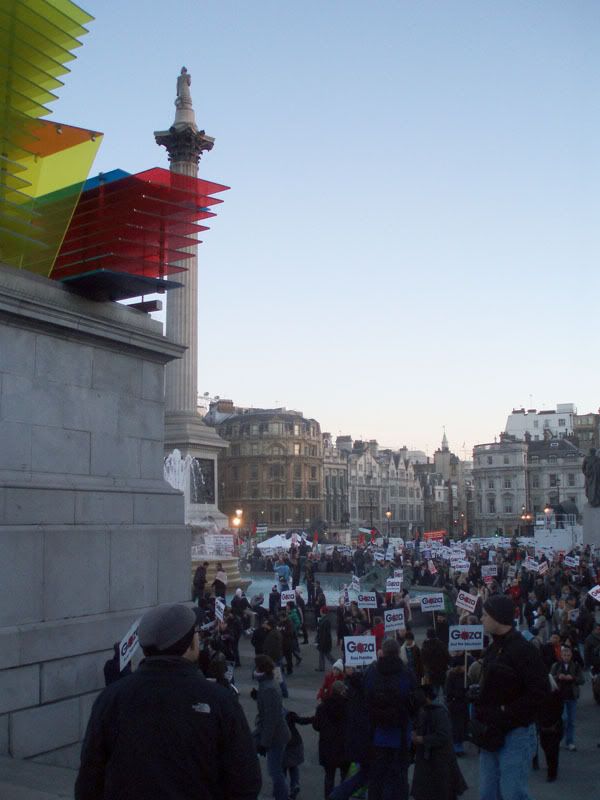
I was in London yesterday (well, technically not "yesterday" now that it's past midnight, but you know what I mean), and I happened to stumble across the Stop the War Coalition protest against the Israeli occupation of Gaza.
You might think it's tricky to "stumble across" a major protest, but this is London, where practically anything can happen and no-one will bat an eyelid. In this case, my first hint that something was going on was the helicopter hovering over the middle of the city. The second was when I came up to Trafalgar Square and noticed quite how many police were around. It seemed that I'd turned up just as the protest reached the Square.


I always find big gatherings like this fascinating. Even if you don't support them (and there's no way I'm going to try and take sides over this one – let's just say that no war is ever a good thing, and that no matter who wins, civilians always lose), the fact that so many people feel so strongly about some issue that they're prepared to take to the streets is always reason enough to hang about for a bit and see what you can see. Especially given that I didn't look out of place (no huge Israeli flag sewn onto my coat or anything), so I could mingle largely unnoticed.


It was a pretty normal protest, really. Incoherent chanting of slogans that distil a complex multi-faceted problem into a few syllables, stony-faced police standing around looking vaguely menacing (although I have to say, I didn't see any police doing anything but a thoroughly professional job when confronted by several thousand angry and emotional people), and of course a bunch of people who were taking advantage of the fact that someone was protesting about something to push their own agenda. The Socialist Worker Party was out in force, as were the people who jump on every criticism of the BBC in order to complain about the licence fee.

In fact, the only things I found disturbing were, first, the slogan on the banner in the photo directly above ("Movement for Justice: By Any Means Necessary", which sounds disturbingly like "the ends justify the means"), and secondly, the absolutely atrocious poetic slogan I saw on a woman's sign. The sign was on lurid pink cardboard, which didn't photograph at all well, so I'll simply reproduce it here:

Mr Brown
Hope you drown
In your shame
CHILDREN DYING
Cause you're
LAME
OK, I get the general feeling, but in my experience the insult "lame" tends to be directed at people who are just slightly gooberish, not at war criminals. Which means that as a protest slogan, it fails on pretty much every level – it sacrifices making sense so that it rhymes, it doesn't scan at all, it peaks far too soon and it fizzles out with a playground insult. If you're reading this, woman with lurid pink sign – seriously, spend a bit more time on your protest posters.

One more thing to say before I leave the whole issue here and move on to less politically-charged topics: I had my headphones on at the time, with my music collection on shuffle. The song that came on as I was looking out over the crowds was the Hot Club of Cowtown's performance of "I Can't Give You Anything But Love"; I leave you with a snippet of the lyrics that seemed to appropriately (if unrealistically) sum up my hopes for this extremely troubled part of the world.
I can't give you anything but love, baby
That's the only thing I've plenty of, baby
Dream a while, scheme a while, you're sure to find
Happiness, and I guess, all the things you've always dreamed of...

Continue Reading...

Sunday, 25 January 2009

PS. Please don't make Joe the Plumber your Secretary of State.

Quick follow-up to my previous post — never let it be said that I fail to give all sides equal time in a debate. Had John McCain won the election, I would have written a message for him as well. Not in the form of a song, but a message nonetheless. It would have looked something like this.

Dear President McCain,

Please, for the love of all that is good, don't die.

Yours sincerely,
Phil

Continue Reading...

Monday, 19 January 2009

No, I will not sing it for you.

Tomorrow, the 44th President of the United States will be inaugurated in Washington, DC. Pretty much all that I know about American politics has been gleaned from episodes of The West Wing and clips of The Daily Show, so my impression of the corridors of power is probably a little off-kilter (I imagine that everyone's beautiful, devastatingly intelligent, deeply moral and absolutely hilarious). But I have managed to get a good sense of the amazing wave of popular support that has carried Barack Obama into the most powerful position in the world.

That's a good thing. After eight years in which we've seen the erosion of civil liberties, an arrogant disregard for the checks and balances that are supposed to keep the powerful accountable, a total economic meltdown and considerably higher levels of terrorist activity than there were in 2000, a bit of optimism can only be a positive influence. Some have thought that there's a danger in going too far. Already people – including Obama himself – are starting to try to scale back the "Superman" image that he's gained.

Well, screw that. Finally we have someone in power with enough support and popular enthusiasm to effect massive sweeping changes in all areas, and we're going to tell everyone that he should take things slowly and carefully, take one day at a time? If you shoot for high targets, you might miss them, but that's a much better idea than settling for the just about acceptable.

There's no real way that I can put this in prose, so I'm going to do something I do very rarely – I'm going to give you a song. Not performed, unfortunately, because I'm rubbish at writing music. But, because this song is (like everything else on this blog) CC-licensed, if anyone reading this wants to have a shot at a tune, go right ahead. Oh, and I wrote it just after the election, hence the complete lack of any mention of Gaza. So anyway, I now present to you...

Please, Mr Obama
A song by Phil

[Intro - slowly and in loose rhythm]
The election is over
The votes are all in
Your administration is soon to begin
These eight long years we've been
At the end of our rope
But now we are seeing a glimmer of hope
To bring about change
You've got to go a long way
And so I have got this one thing to say...

[Verses - much perkier tune, jangly rhythm]
Please, Mr Obama, don't screw it up now
The last guy did so many things you just can't allow
Shut down the secret prisons of the CIA
Make sure you ban torture - and by the way
Send Bush and Cheney off to Camp X-Raaaaaaay [hold long note]
About a week before you close it down
Oh please, Mr Obama, don't screw it up now

Please, Mr Obama, keep to your word
Carry out your promises, don't ever be deterred
Get jobs for all who want to be employed
Give free healthcare to every girl and boy
Make 'em proud back in Illinoiiiiiiiiis
For politicians this might be absurd
But please, Mr Obama, keep to your word

Please, Mr Obama, keep the peace
Do everything you can to make the violence decrease
There's war in Iraq, we're not sure 'bout Iran
Full-blown anarchy in Afghanistan
And let's not forget the DRC and Sudaaaaaaaaaaan
But we believe miracles never cease,
So please, Mr Obama, will you keep the peace

Please, Mr Obama, keep the Union strong
Don't back down when half of Congress thinks you're wrong
Lose the bad policies of yesterday,
Turn the country round 'til it's going the right way
Make the world proud of the US of AAAAAAAA
Although they won't always get along,
Please, Mr Obama, keep the Union strong

[Outro - slow once again]
You've got four years
And maybe even eight
It's not all that much but you can make it great

So much to do
So face it with a smile
And don't let Sarah Palin within twenty miiiiiles...

[Coda, perky again]
I'm so glad America decided to select
You as its brand-new President-Elect
But please, Mr Obama, don't screw it up nowwwwwwww!


Of course, the next question is, how on earth are people going to write protest songs for the next four years?

Continue Reading...

Sunday, 18 January 2009

I will call him Squishy and he will be mine, and he will be my Squishy.

Ahem. I'm aware that rather a lot of recent posts have opened with an apology for not posting enough, and leaving a month since the last one is something of a record. So, sorry. But hey, it's the Internet, where the vast majority of people who ever read this will be doing so by reaching it through a Google search for something hopelessly vague, several months after I post it. (The number who get here by Googling something like "hypothesis on beauty" is remarkably high.)

We're well out of the Christmas season, and into what certain members of my family term "Winterval", which is essentially an excuse to have open fires every night until Easter and watch old episodes of The West Wing. Not that I'd usually be complaining about this, but as it happens this is the first year since Winterval was founded that I've been living in a completely different city, and I am therefore going to have to console myself with fake open fires and episodes of CSI.

What was I talking about? Oh, yes, Christmas. My younger sister (notable on these pages for her slightly snarky comments recently) received the Pixar box set for Christmas, which has meant that the whole family has been basking in what are pretty much the only good animated films that Disney has released for about the last 12 years. They're also some of the only ones with original stories, Disney having exhausted their stock of family-friendly fairy tales some time ago. However, just because they have new stories, that doesn't mean that they can't use Disney's oldest and best-used storytelling trope: deeply broken families and desperate tragedy.

That might seem strange. Disney films are explicitly aimed at children, after all, and they do have something of a reputation for being saccharine and schmaltzy. However, that's only ever the case towards the end of the film as the happy resolution is approaching. Looking only at the opening premise, the number of on-screen families where something is badly wrong is just astounding. Here's a relatively recent selection.

Film (Year)Setup
The Little Mermaid (1989)Ariel's mother doesn't appear throughout the movie. That said, maybe mermaids reproduce like fish and Ariel is one of five million offspring of King Triton. Who knows?
Beauty and the Beast (1991)Belle's mother is not only absent, she's never even mentioned. And although the Beast clearly has rather more pressing problems than just having no family, he apparently has no living parents either.
Aladdin (1992)Aladdin is an orphan, and Princess Jasmine has – you guessed it – no mother either.
The Lion King (1994)Mufasa and Sarabi may be a happy pair of lions at the beginning of the movie, but it's not long before Mufasa is being trampled to death in an unusually shocking scene. I don't recall corpses of major characters being shown in any other Disney film, even if Mufasa's looks rather less buffalo-trampled than you might expect.
Pocahontas (1995)Oh, this is getting ridiculous. Guess who's dead as this movie opens? Yep, Pocahontas's mother.
Toy Story (1995)Now we're into Pixar territory, with the world's first CGI feature film. And things have changed enormously. Yes, this time it's Andy's father who is conspicuous by his absence.

I could go on, but I think you get the idea. So with that context, let's have a closer look at the extremely impressive 2003 Pixar effort, Finding Nemo. Nemo, our little clown fish hero, is not only without a mother (who, predictably, dies horribly in the film's opening scene), he's also disabled. Oh, and he lives inside an anemone to protect him from the thousands of fish who want to eat him. Life's hard for him from the word go. Marlin, his father, has some deep-seated emotional issues that manifest in extreme over-protectiveness. And then we have Dory.

Dory is definitely my favourite character in this film. She gets some of the best lines, including the whole "you can speak WHALE?" scene (Ellen DeGeneres voices her superbly, by the way) and the way the script deals with the character's short-term memory loss is hilarious without laughing at the medical condition itself. Well, not too much, anyway.

Dory's hilarity, though, distracts from the fact that her situation is terribly sad. We get that the first time we meet her, with the line "No, it's true, I forget things almost instantly. It runs in my family. Well...at least, I think it does. Umm..hmm. Where are they?" In a way, that's worse than the way the above-mentioned characters have lost one or more members of their family. If they had simply died, Dory could find a way to cope with that (even if, like Marlin, it's a very bad way). However, she knows they're somewhere out there in the ocean, but has no idea where. Her memory loss cuts her off in a very fundamental way from everyone around her. (More on that in a later post.)

It's towards the end of the film that we get the worst part. It's the low point for the main characters anyway: Marlin has just seen what he thinks is Nemo's dead body and is slowly heading home, defeated. Dory can't bear to see him go, and pleads with him not to leave her:
"Please don't go away. Please? No one's ever stuck with me for so long before. And if you leave... if you leave... I just, I remember things better with you. I do, look. P. Sherman, forty-two... forty-two... I remember it, I do. It's there, I know it is, because when I look at you, I can feel it. And-and I look at you, and I... and I'm home. Please... I don't want that to go away. I don't want to forget."
For my money, that's pretty close to the saddest thing any character says in any Disney film. Dory has finally found a way of tenuously re-connecting herself to a world that she has effectively lost (the mention of "home", connected with the earlier revelation that Dory has no idea where her home actually is, serves as a particularly effective twist of the knife), and now that's disappearing, literally in front of her eyes. And Marlin – possibly understandably at this point – does absolutely nothing to help.

One of the reasons why Disney movies have passed into film legend – and particularly why pretty much all the Pixars have – is that they end well. Unlike Steve Spielberg, who clearly has some horrible mental illness that causes him to add between ten and thirty completely unnecessary minutes to the end of every film he directs, Disney directors know that they have to wrap up all the loose ends in a happy and fulfilling way, ideally taking us back to the situation we saw at the start to show how it's changed, and then just stop. So in Beauty and the Beast, the final shot is in the same stained-glass style that we saw in the prologue, The Lion King ends with Rafiki holding up Simba's daughter on Pride Rock in the same way that he held Simba in the opening scene, and Finding Nemo closes with Marlin chivvying Nemo off to school, in a neat role reversal from a similar scene near the beginning.

I think that's why Disney gets away with putting so much tragedy into their films. Kids watching them may be scared at the appropriate points (I knew someone who, at the age of 18, was still unable to watch Mufasa's death in The Lion King without crying), but they know that when they reach the end, the villain will have received his suitably violent and frequently deliciously ironic comeuppance, the comic relief will be heading off into the sunset to do something wacky and/or zany, and the guy will get the girl. It's a simple formula, but one that works, and that nearly guarantees a good story.

Oh, and most importantly, they all live happily ever after.

Continue Reading...