
[taken during week running from 9/07 to 15/07]
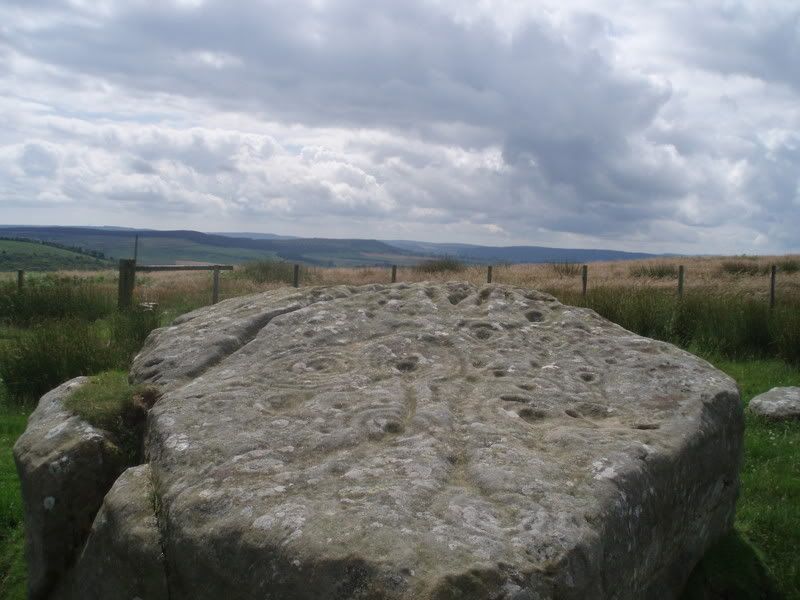
Same photographer, different holiday...we're now in Northumberland on the Grand Tour of Catching Up With Photos, and what better way to celebrate the wonder that is Northumberland than with...a large lump of rock?
Ah, but not just any lump of rock. For this, you see, is a cup and ring marked stone. To paraphrase the Wikipedia article I just linked you to (which seems to be based largely on the terrifyingly detailed work done by one Stan Beckensall), these are various...well, large lumps of rock...with a whole bunch of prehistoric carvings on them. No-one has the faintest idea who made them, or for what purpose, or indeed precisely when - Bronze Age is about as close as most people seem to be able to get. This does make one wonder quite how the illustrious Mr. Beckensall has managed to spin the subject out into multiple books without descending into dramatised accounts of druids and so forth. For all I know, that's precisely what he has done.
Beckensall aside, the reason these rocks hold a special place in the hearts of my family is that this is the first time we've ever found one. This state of affairs is not for lack of effort on our part. We've been to Northumberland twice before, and I think both times we've seen the said lumps of rock labelled on the OS map (you can see some of them here if you're really interested) - however, neither of those times did our long searches through waist-deep damp bracken on the sides of gloomy windswept hills ever yield anything that looked remotely cup-and-ring shaped. This time, though, we went prepared, equipped both with a set of walkie-talkies and a printout from this very helpful, not to say obsessive, website.
And find them we did, allowing me to bring you the above photo. I sincerely hope that all those who see this will be grateful that they now also know nothing about why some Bronze Age vandal felt the need to carve circular grooves into a perfectly harmless piece if rock. It's a valuable service that I perform here.
Tuesday, 7 August 2007
Picture of the Week: #28

Monday, 6 August 2007
Only vaguely connected, but: Why on earth would anyone name their daughter "Paris Hilton"?
If I were to tell you that there existed an industry in the vast majority of cultures around the globe, one which involved providing temporary homes for people for amounts of time ranging from a few hours up to months or years, and which is entirely dependent on these people being away from their families and friends for reasons which do not involve financial hardship, I suspect you'd probably either laugh at me or at least give me a very strange look. If you knew me, though, you'd probably think I was asking you a trick question, so you'd probably think about it a bit more and realise that I was talking about the hotel industry.
As with so many other aspects of life, it's easy not to notice quite how weird the concept of a hotel really is. It's become less so in relatively recent times - in an age when you can be in almost any city on Earth within 24 hours, it's entirely normal to be away from home for long periods, and since the appearance of the species Businessmanus Jawdroppinglywealthi it's understandable that establishments can charge amounts that would make Solomon weep. But why should hotels (or inns, at any rate) have likewise appeared in mediaeval times, when hardly anyone lived more than a couple of miles away from the rest of their family and acquaintances? How about the inns mentioned in the Bible? Did they really subsist on the trade caused by the odd donkey salesman passing through? The universality of this concept is one that I find really puzzling.
Being one of the huge number of former students without an income, any time I need to experience the services of these establishments I'm forced to go down to the rather cheaper end of the spectrum. In the UK, this largely doesn't exist, but luckily if you go abroad there are more options. For example, the photo below is of Hotel F1 in the town of Beaune in the middle of France.
It's certainly not a beautiful building, and that impression is strengthened once you see the rooms - the overall impression I got was of staying inside an oversized Lego brick. All of the rooms were identical, holding a double bed with a single bunk over the top, a tiny desk in one corner, a TV suspended above it, and a sink in another corner. Toilets and showers were communal, and there weren't very many.
On the positive side, the whole place was kept very clean, and it was incredibly cheap - 27 Euros per room per night, regardless of how many people were in each room. (Within reason.) For real cheapness, though, going to Africa is the way forward. I think the cheapest establishment I found in Uganda when travelling alone cost 7,000 Ugandan shillings a night. In British terms, that's £2. And yet, a certain grubbiness and lack of TV (or any other technology) aside, the facilities were very similar to the Beaune offering.
I think this means that there's some kind of sliding scale of hotels. Within the middle band, paying noticeably more results in noticeably better facilities - maybe by measuring the number and value of complimentary items you get, you could produce some kind of linear relationship. Get near the top of the scale, though, and you'll end up paying vast amounts of money without anything improving all that much. There's only so much training you can give hotel staff - no matter how much emphasis you put on the customer's wellbeing, you just can't turn them into soulless automatons. (I'll resist the temptation to make a joke about McDonald's employees.) Likewise, things like solid silver swimming pools and chlorinated cutlery don't really add to the enjoyment as much as their cost suggests.
Similarly, down at the bottom end of the scale you get limited by the law. Given that you simply cannot put your customers on a bare patch of dirt for the night and charge them for it, there exists a lowest level of service possible, and no matter how little money you pay, you will receive that level. And, given that hotels, like any other business, will set their prices according to what people can pay, all you need do is go somewhere with almost no wealth in the general population, and you'll be paying rock bottom prices for the basic comfort level.
The fact that some people feel that they can't bear a level of comfort quite this low is, I think, their problem...

Friday, 3 August 2007
Picture of the Week: #27
[taken during week running from 2/07 to 8/07]
We're still in France for this retrospective Picture of the Week, but not in Ampus - this one was taken in the town of Grasse, right down by the south coast. The same lazy atmosphere as is experienced in the small villages can be found in the big towns of the south of France, just to a lesser extent. This is probably because the towns have most of the main industries, but can also attract tourism - there's just more going on.
The architecture, though, doesn't reflect that so much. Everywhere you go in Grasse, the buildings tower up to 3 or more stories, the alleyways between them are thin enough to give a claustrophe nightmares for a month, and wooden shutters cover every window - all of these are ways of keeping the streets and houses cool in the ever-present heat. Escaping from the weather, in fact, is such a major concern that it's a wonder anyone ever comes outside. There are ways of getting around that, of course, such as the drinking water fountains (when was the last time you saw one of those on a street in the UK that was actually working?) and the beautiful tree-lined avenues. It's a lovely place to spend an afternoon, and the major industry of the town - perfume manufacture - means that it smells amazing too.

Thursday, 2 August 2007
Can it actually be a utopia without hover-bikes, though?
One of the things I've been doing on holiday is catching up on my classic science fiction reading. (Incidentally, that's science fiction or SF, not sci-fi. Apparently they are very different. I have no wish to rouse the wrath of the world's collected nerds, so I will follow this nomenclature despite having no idea why it should be in place. Isn't social convention wonderful?) This has consisted mainly of reading a huge and chunky compilation of H.G. Wells's novels, Wells being one of those authors who I've always meant to read but have never quite got round to.
The compilation was very entertaining to read - I had no idea that Wells was capable of writing stories that are not only scientifically consistent (for example, if the story calls for time travel to be possible, a suitably hand-wavey explanation for it is concocted, but then every other element of the story remains consistent with the results of this explanation), they're also really well-written and very witty. The Invisible Man, for instance, concentrates very little on the title character, and far more on the people who have to deal with him on a day-to-day basis, giving Wells an excellent opportunity to focus on the absurdity of the events that they perceive. What's more, the stories are frequently applicable beyond themselves - Wells went so far as to explicitly say (in the introduction to the compilation) that he's been "talking in playful parables to a world engaged in destroying itself". Elements of this appear throughout the stories, whether it's in the form of the giant children in The Food of the Gods noting how strange it is that those with money just tend to sneer at those without, rather than helping them, or whether it's the startlingly lucid and cynical passage about the tendency of people to turn on their fellow man if it will help them that appears near the end of The War of the Worlds.
The most obvious place in which this preaching to the audience occurs is In the Days of the Comet, which is little more than a simple presentation of the world as it was when Wells was writing, followed by a presentation of the world as he thought it should be, tied together by a slightly laboured love story. In some places, Wells makes excellent points - his description of the crippling poverty and blatant social injustices suffered by the have-nots of the world is eye-opening, and suddenly makes it rather more obvious why Communism took hold in the popular imagination quite so firmly in the first half of the 20th century. Other aspects are, if not all that believable, at least interesting because of the time at which they were written - his vision of "the swift, smooth train" that he clearly thought would be the result of widespread access to electricity is a very similar concept to the flying car that I thought I'd be driving "in the future" for much of my childhood.
One of the most striking things that Wells does, though, is to change religion as well, in much the same way as it's being changed nowadays by popular opinion. Have a read of this passage, describing the narrator's mother in the new, changed world.She kept to her queer old eighteenth-century version of religion, too, without a change. She had worn this particular amulet so long it was a part of her. Yet the Change was evident even in that persistence. I said to her one day, 'But do you still believe in that hell of flame, dear mother? You - with your tender heart?'
She vowed she did.
Some theological intricacy made it necessary to her, but still -
She looked thoughtfully at a bank of primulas before her for a time, and then laid her tremulous hand impressively on my arm. 'You know, Willie dear,' she said, as though she was clearing up a childish misunderstanding of mine, 'I don't think anyone will go there. I never did think that...'
Now, although I'd be the first to say that I really hope that Willie's mother is right in this regard, I would never go so far as to label the concept of hell as a "childish misunderstanding". It's far more serious than can be simply brushed away like that, and doing so betrays an underlying attitude that "religion is just what we make it" - an attitude that makes it worse than useless, as it suggests we're all deliberately fooling ourselves. Frank Herbert does something very similar in his classic Dune. From the appendix at the back of the book comes this little gem, placed in the mouths of the "Commission of Ecumenical Translators":'We are here to remove a primary weapon from the hands of disputant religions. That weapon - the claim to possession of the one and only revelation.'
Not only is this a pretty blatant reworking of the "blind men describing the elephant" metaphor (and it's just as arrogant and internally inconsistent a concept as is that one - claiming that no-one has the single correct revelation is itself a claim to have that kind of revelation), it also instantly writes off religion as being human-created. Just in case Herbert's audience hadn't got the concept, he hammers it home a few paragraphs later by reporting that the Commission's work was said to be "filled with a seductive interest in logic" and that it shouldn't have tried to "stir up curiosity about God". The obvious implication is that the whole edifice of religion is based on irrationality and shouldn't be inspected too closely, lest it come tumbling down.
This is a theme that I'm planning to return to shortly, so I won't keep on at it now. I just think it's worth noting that utopias and "advanced" societies aren't always all they're cracked up to be, and that they seem to have a tendency to insist on humans being the only force that can influence their own destinies. It would be nice to see a little humility in this kind of fiction - if we're going to look at how humans could develop in the future or after a major event, why can't we sometimes accept that we're rather less in control of our own fate than we might like to think?
Wednesday, 1 August 2007
Picture of the Week: #26
[taken in week running from 25/06 to 1/07]
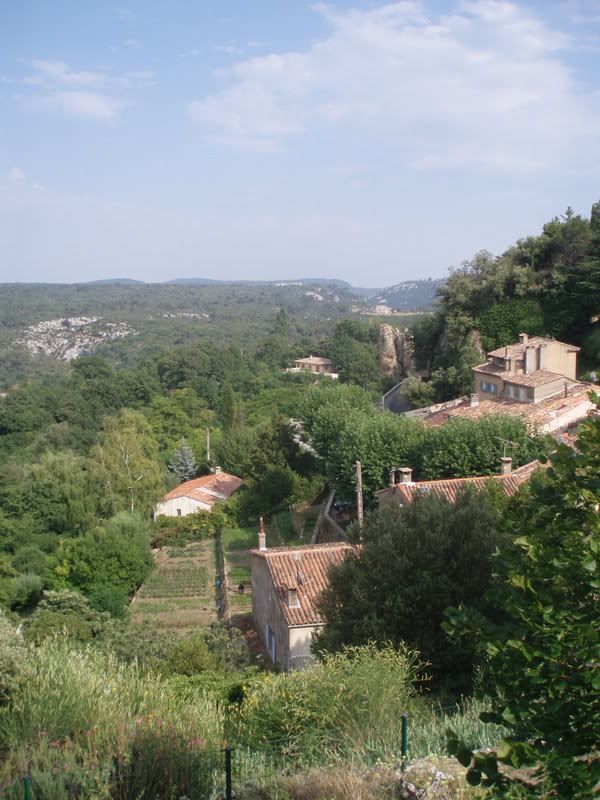
For the first of my PotWs...from the past...(cue Twilight Zone theme)...we're in France. Specifically, Provence, and even more specifically, a little village called Ampus, perched on the side of a hill. It's so much your typical south-of-France village that it's just ridiculous - sandy-coloured buildings with terracotta-coloured roofs, wooden louvred shutters on all the windows, and a very strong overall atmosphere of contentment and ease.
No-one runs around here, it's too hot. Neither does anyone seem to get annoyed at anything. Or spend much time doing anything during daylight hours, come to think of it. This is the land where the siesta is king, where the church clock (and I swear I am not making this up) chimes each hour twice, with a break of a couple of minutes in between, presumably to confirm what you thought you heard earlier when it woke you up from your pleasant afternoon snooze.
It's not a place for bright young things with boundless energy and great plans...but then, why would you want that anyway?
Tuesday, 31 July 2007
Errr...new haircut?
I'm aware that it's something of a cliché for men to be completely oblivious when their significant other has changed some aspect of their appearance. It's also something of an unfair cliché; I, for one, generally do at least pick up that something's different, it just takes me a little while to work out what.
I don't think, though, that anyone reading this can fail to have noticed the subtle changes that have occurred on The Beautiful Hypothesis - what can I say, green was getting a bit boring. The only major addition to the design is the last.fm albums "quilt" - despite my general antipathy towards animated widgets on blogs, I did think this one was rather fine, and it has the added bonus that you can laugh at/be entirely puzzled by my music taste.
As you've probably realised, the redesign has come about because I've now finished all of the travelling I'm likely to be getting up to this summer, and therefore The Beautiful Hypothesis can come off its hiatus and return to updating. There's quite a lot to catch up on - over the next few days (and possibly weeks) I'll be discussing some of the things that have come up over the holiday, and of course there are quite a few Pictures of their respective Weeks to be posted.
Because I've posted since going away, I won't be posting retroactively, meaning that the week in which a picture is posted may bear absolutely no relation to the week in which it was taken. Hopefully this won't be too confusing. Anyway, it's good to be back - with a bit of luck posting will be ramped back up to its normal rate within a couple of days.
Tuesday, 10 July 2007
By the way...
Not really coming off hiatus - just thought I should acknowledge the good news that Alan Johnston has been released. The support banner that I was displaying on this blog has therefore disappeared from the sidebar.
I don't know whether the many people who tried to raise awareness about Johnston had any effect on his release - nor do I know whether Hamas is going to gain politically from this move. Quite frankly, though, those things simply don't matter right now. Alan Johnston's free and back with his family, and that's worth celebrating.


